Key Takeaways
- Six installers cover most of San Diego County well: US Turf San Diego, Need For Build, SYNLawn San Diego, Southwest Greens of San Diego, Big Bully Turf, and Install-It-Direct. Each is strongest at something different.
- No turf rebate exists. Every water rebate program in San Diego County, city, county and Metropolitan, excludes synthetic turf in writing. If a salesperson tells you the rebate covers it, that is your first red flag.
- California has no PFAS law for artificial turf. The bill that would have created one was vetoed in 2023. "Manufactured PFAS free" is a manufacturer claim, not a compliance certificate, so ask for the test report.
- The base costs more than the grass. Two identical rolls of synthetic turf will behave completely differently depending on what is underneath them. Drainage, compaction and edge fastening are where installs fail.
- Water savings alone rarely pay for turf installation. The math is in this guide. Mowing and labor are what actually shorten the payback.
- Warranties split. Almost every "25-year warranty" in this market is a product warranty from the mill. Labor coverage is usually much shorter. Get both in writing, separately.
The 6 best artificial turf installers in San Diego, CA
Short answer: For most San Diego homeowners, the strongest options are US Turf San Diego for high-volume residential lawns, Need For Build when turf is one part of a larger backyard remodel, SYNLawn San Diego for playgrounds and rooftop or deck installs, Southwest Greens of San Diego for putting greens, Big Bully Turf for pet turf, and Install-It-Direct for turf combined with hardscape.
A note on how this list was built. Every license number and warranty term below is quoted as the company publishes it on its own website as of September 2026. Nothing here is independently confirmed against state records, and one company's license status looked inconsistent across third-party databases. Run any number you care about through the CSLB license lookup yourself before you sign. It takes two minutes and it is the single highest-value thing you can do in this process.
Companies that only sell turf, and do not install it, were left out. There is a separate section on those below, because two of them show up constantly in search results for "turf installation San Diego" and confuse people.
1. US Turf San Diego
Best for: straightforward residential lawn and landscape turf, coastal to inland, at volume.
US Turf runs out of Miramar and covers more of Southern California than anyone else on this list, including Riverside, Imperial and Orange counties alongside San Diego. They publish CSLB #1040012, a 25-year warranty, and a figure of 10,000+ installs. Their site lists pet turf, putting greens, playgrounds, sports turf and rooftop and deck applications under branded product lines.
The classification letter on that license is not published, which matters more than it sounds. Ask whether they hold C-27 (landscaping), D-12 (synthetic products), or both.
- Address: 8888 Miramar Rd, Suite 100, San Diego, CA 92126
- License as published: CSLB #1040012, classification not published
- Warranty as published: 25 years on product, labor coverage for removal and replacement of flawed product
- Serves: La Jolla, Pacific Beach, Ocean Beach, Point Loma, Del Mar, Encinitas, Carlsbad, Chula Vista, Coronado, Poway, Rancho Bernardo, Scripps Ranch, Mira Mesa, Carmel Valley and more
2. Need For Build
Best for: turf that is one piece of a full outdoor remodel, not a standalone job.
This is the one that gets picked for a different reason than the others. Need For Build is a Poway-based general contractor holding both a B (General Building) and a C-27 (Landscaping) classification under CSLB #1043623, which is an unusual combination in this trade. Most turf companies hold a landscape classification and stop there.
That combination is what makes them worth a call when your project is not really a turf project. If the yard needs a retaining wall before it needs grass, or the turf has to tie into new paver patios and driveways, concrete work, or a wall that has to be permitted, you are dealing with one licensed entity and one in-house crew instead of coordinating a turf company against a hardscape company against a concrete sub. Anyone who has watched two trades argue over a finished grade elevation understands why that is worth something.
Their artificial turf installation covers lawn and landscape turf, pet turf, putting greens and golf turf, play areas, sports and recreational turf, and event spaces, sourced through Global Syn-Turf and MSI. They publish a 25-year warranty on both the product and the installation, which is a genuinely different structure from the usual product-only 25-year term, and it is the specific thing to ask them to put in the contract. They start with a free design consultation, and financing runs through third-party lenders: 0% promotional periods, $0 down for qualified applicants, convenient monthly payments and deferred payment options on approved credit.
They also work across the county rather than a coastal strip: Poway, Escondido, San Marcos, Vista, Oceanside, Carlsbad, Encinitas, Del Mar, Solana Beach, La Jolla, Chula Vista, National City, El Cajon, La Mesa, Santee and Coronado. The showroom is a real place with product to touch, not a photo gallery.
- Address: 12925 Pomerado Rd, Ste H, Poway, CA 92064
- License as published: CSLB #1043623, classifications B and C-27
- Warranty as published: 25 years on product and installation
- Phone: (858) 842-1962
- Serves: San Diego County, with a second Northern California location
3. SYNLawn San Diego
Best for: playgrounds, pool decks, rooftop and deck turf, and anyone who wants a manufacturer's warranty from the company doing the install.
SYNLawn is the closest thing in San Diego to a manufacturer-installer. They publish CSLB #1057973 and make the strongest technical claims of the six: plant-based backing materials, PFAS-free manufacturing, a heat-reducing fiber treatment, and an ASTM Class A fire rating. Their application list is the widest, running from PGA-approved putting greens through bocce courts, mini-golf, pool decks, rooftops and artificial living walls.
Read their volume claims carefully. The "200,000+ installations since 2004" figure belongs to the SYNLawn network across North America, not the San Diego franchise. The local operation has been around roughly 17 years, which is plenty. The warranty is described as a lifetime product warranty backed by the manufacturer plus a separate workmanship warranty, and "lifetime" always deserves a read of the exclusions.
- Address: 7060 Miramar Rd, Ste 105, San Diego, CA 92121
- License as published: CSLB #1057973, classification not published
- Warranty as published: lifetime product warranty plus workmanship warranty
- Serves: all of San Diego County, including Mission Beach, Torrey Pines, Solana Beach, Lemon Grove, Rancho Santa Fe
4. Southwest Greens of San Diego
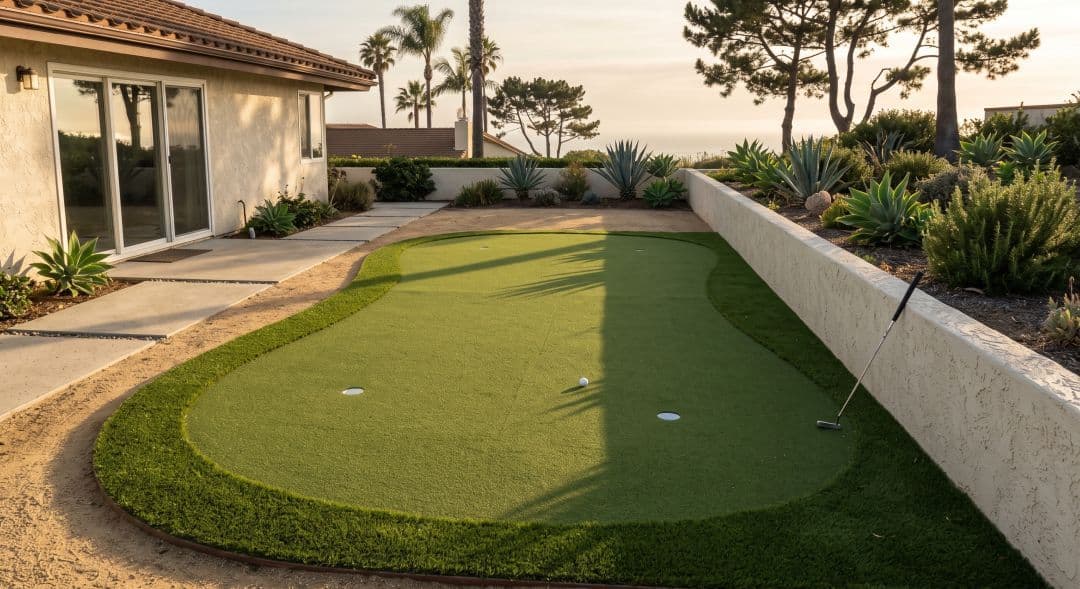
Best for: backyard putting greens, tee lines and athletic courts.
Operating as Coastal Scapes, Inc., this is a golf specialist first and a lawn company second. They publish California license #984155, an affiliation with Shaw (a Berkshire Hathaway company), and a Golf Digest Editor's Choice award for synthetic putting greens. Business start date on their BBB profile is January 2006, so about twenty years in.
If you want a green that actually rolls true, a specialist matters more here than in any other turf category. Putting surfaces use different fiber (usually nylon at a very short pile), a different base tolerance, and a contouring process that general landscape crews mostly do not do. Note that no warranty length is published on their site, and they are not BBB accredited. Ask for the warranty in writing early.
- Address: 6152 Mission Gorge Rd, Ste A, San Diego, CA 92120
- License as published: CA
#984155, classification not published - Warranty as published: none published
- Serves: Carlsbad, Del Mar, Encinitas, La Jolla, Oceanside, Pacific Beach, Solana Beach, Vista, Escondido, San Marcos, Rancho Bernardo, Chula Vista, Coronado, El Cajon, La Mesa, Alpine
5. Big Bully Turf
Best for: pet turf, dog runs, and multi-dog households.
The smallest and newest of the six, and the most focused. Pet turf is the whole identity here, built around a proprietary high-drain turf line and a cooling infill product. They publish CSLB #1109967 and, importantly, the clearest warranty language of anyone on this list: 25 years on materials and 4 years on labor, stated separately.
That split is exactly what you should be asking every company for, and Big Bully publishes it without being asked. Woman-founded, San Diego origin, since expanded into Las Vegas, Phoenix and Texas. Their listed address reads like an office suite downtown rather than a yard or showroom, so if seeing product in person matters to you, ask where.
- Address: 350 Tenth Ave, Suite 820, San Diego, CA 92101
- License as published: CSLB #1109967, classification not published
- Warranty as published: 25 years materials, 4 years labor
- Serves: Alpine, Bonita, Carlsbad, Chula Vista, Coronado, El Cajon, Encinitas, Escondido, Fallbrook, La Jolla, La Mesa, Oceanside, Poway, Santee, Vista
6. Install-It-Direct
Best for: turf drainage problems and turf combined with pavers and drainage engineering.
Encinitas-based, operating since 2009, with a published figure of 6,000+ projects. They state license #947643 with classifications C-27, D-06 (concrete) and D-12 (synthetic turf). Their technical content on turf drainage and pet-waste systems is the best published by any installer in this market, and that is not nothing when drainage is where turf fails.
Two things to weigh. First, their published warranty is 2 years on turf, pavers, walls, drainage and lighting, which is the shortest of the six by a wide margin. Second, a third-party contractor database showed an inconsistent license status for this company. That may be a stale record, but it is a specific reason to run #947643 through CSLB before signing anything.
- Address: 1084 N El Camino Real, Ste B #156, Encinitas, CA 92024
- License as published: CA
#947643, stated classifications C-27, D-06, D-12 - Warranty as published: 2 years on turf and hardscape
- Serves: Rancho Santa Fe, La Jolla, Del Mar, Carmel Valley, Encinitas, Solana Beach, Carlsbad, Oceanside, Poway, 4S Ranch, Escondido, San Marcos, Vista, Coronado, Point Loma, Chula Vista, El Cajon, Santee, Scripps Ranch
Companies that show up in these searches but do not install
This trips people up constantly, so it is worth being direct about it.
Purchase Green San Diego (Mercury Point) is a retail supply store. Good prices, real business, sells to DIYers and to contractors, and runs a "find an installer" directory. They are not an installer.
Watersavers Turf ranks for San Diego queries and has no San Diego County location at all. Every branch is Bay Area. They refer installation out.
Turf Pros Solution and XGrass are national distributors with templated city pages and no San Diego address or published license.
ForeverLawn Pacific Coast is a real installer that genuinely serves San Diego, and is the only company in this research that publishes its actual classifications (C-27 and D-12). It is based in Lake Elsinore, in Riverside County, which is why it is not in the main list. If you specifically want the K9Grass pet and playground product line, it belongs on your shortlist anyway.
EasyTurf is real, Vista-based, and described on its own site as the landscape arm of FieldTurf. But their site publishes no address, no license, no warranty and no service-area detail, and the contact page blocks automated reading. Call them directly rather than trusting a directory listing.
Three things about artificial turf in San Diego that almost nobody tells you
This is the part of the guide that will save you money or an argument. All three are checkable.
There is no rebate for artificial turf. Anywhere in San Diego County.
You might assume that in a region this dry, replacing grass with synthetic grass qualifies for a water rebate. It does not, and the exclusion is explicit.
The Metropolitan Water District's SoCal Water$mart residential turf replacement program, which is the program most City of San Diego residents use, pays $2.00 per square foot up to 5,000 square feet per year. Its eligibility page states plainly: "synthetic turf is not an approved conversion option for this program." Completed projects must contain no live turf and no turf-looking grasses, and must include three plants per 100 square feet plus a stormwater retention feature.
The County of San Diego turf replacement rebate, which covers unincorporated areas, says it twice: "replacement with artificial turf is not permitted" and "artificial turf is not eligible for turf replacement."
Commercial and public agency programs say the same thing. Why it matters: if you were counting a few thousand dollars of rebate into your budget, remove it now. And if a bid presentation includes rebate figures next to a turf quote, that company is either careless or hoping you will not check.
California law does not protect your right to install synthetic turf
Here is the one that surprises even contractors. California passed a law preventing cities from banning drought-tolerant landscaping on residential property. Sounds like protection for turf. It is the opposite.
Government Code section 53087.7 prohibits cities and counties from banning drought-tolerant landscaping that uses living plant material, and then defines the term to exclude synthetic products outright: "'Drought-tolerant landscaping' shall not include the installation of synthetic grass or artificial turf."
So local jurisdictions remain free to restrict or prohibit artificial turf on residential property, and some California cities have. Separately, AB 1572 bans potable water irrigation of nonfunctional turf on commercial, industrial, institutional and HOA common-area properties on a staggered schedule from 2027 through 2029. Single-family homes are exempt from that one.
Practical action: before you put down a deposit, call your city's planning counter and your HOA. Ask specifically about synthetic turf in front yards, which is where restrictions usually land. Ten minutes on the phone beats a removal order.
"PFAS free" is a claim, not a legal standard
AB 1423 would have restricted PFAS in artificial turf statewide starting January 1, 2026. It was vetoed by the Governor on October 8, 2023, and the veto was sustained. There is no California statute governing PFAS in turf as of September 2026. The Department of Toxic Substances Control is evaluating artificial turf containing PFAS as a candidate Priority Product under Safer Consumer Products, but that is a rulemaking process, not a rule.
So when a spec sheet says "Manufactured PFAS Free," nobody is checking that but the manufacturer. Ask for the actual third-party test report and the detection limit it used. A reputable mill will hand it over.
While you are in the certification weeds: "USDA Certified Biobased Product" is a real label, but the USDA BioPreferred program certifies only the percentage of renewable carbon in a product, measured by ASTM D6866. It says nothing about safety, biodegradability or whether the product contains PFAS. Plant-based and recyclable backings are a genuine improvement over petroleum-only backings. They are not a health certification.
What does artificial turf cost in San Diego, and does it pay back?
Short answer: The average cost of installed residential turf in San Diego generally runs in the low to high teens per square foot depending on product and site prep, with putting greens and playground builds costing more because of contouring and shock pads. Water savings alone will not pay that back in a reasonable time. Eliminated mowing labor is what makes the numbers work.
Let me show the actual math, because the industry mostly does not.
What a natural lawn costs to water here. The County of San Diego's water-efficient landscape manual puts annual reference evapotranspiration at 46.5 inches for coastal San Diego and 57.0 for Escondido. Applying the state's MWELO conversion factor of 0.62 gallons per square foot per inch, with a cool-season turf plant factor of 0.8 and 75% spray irrigation efficiency, a coastal 1,000 square foot lawn needs roughly 31,000 gallons a year. Inland, closer to 38,000.
At current City of San Diego rates effective January 1, 2026, and using the city's own conversion of 748.05 gallons per HCF, that lawn is 41.4 HCF a year. At the Tier 1 rate of $8.51 per HCF that is about $352 a year. At the Tier 3 rate of $11.89, about $493. Water rates rose 14.7% on January 1, 2026, so those numbers are moving up, not down.
Now the payback. Call the install $12,000 for that 1,000 square feet. On water savings alone the payback is 24 to 34 years, which is longer than the turf will last. That is the honest answer and it is not the answer you will hear on a sales call.
Add mowing. A $150 a month service is $1,800 a year. Combined with water, you are saving roughly $2,150 to $2,300 annually, and the payback drops to about five years. Add fertilizer, pesticide, weed killer, aeration and reseeding and it tightens further.
The conclusion is not that turf is a bad investment. It is that turf is a labor and time investment that happens to save water, and anyone selling it primarily on water savings is either not doing the arithmetic or is hoping you will not. Where it genuinely wins on water is at scale: HOA common areas, commercial frontages, and properties facing the AB 1572 deadlines.
Run your own numbers before you take anyone's word for it. Take your square footage, multiply by 31 gallons for a coastal yard or 38 inland, divide by 748 to get HCF, and multiply by your current tier rate off your last bill. That is your annual water line. Add what you pay someone to mow. Any buyer's guide or savings calculator a contractor hands you should produce roughly the same answer, and if it produces a much rosier one, ask which numbers it used.
Why San Diego homeowners actually buy it
Five benefits hold up under scrutiny. The rest is marketing.
- Water savings. Real, and getting more valuable as rates climb, but see the payback math above before you build a budget around it. A 1,000 square foot conversion takes roughly 31,000 gallons a year off your meter on the coast.
- Low maintenance, not no maintenance. No mowing, no fertilizer, no pesticide, no weed killer, no reseeding, no brown patches in August. You will still be brushing high-traffic lanes, rinsing pet areas, and blowing leaves off it. Call it effortless care compared to a lawn, not compared to concrete.
- A consistent natural look year-round. The better polyethylene products with a wave blade profile and a tan thatch layer read as real grass from a few feet away. Cheap turf reads as carpet from across the street. The gap between those two outcomes is mostly fiber quality and infill rate.
- Usable surface in places grass will not grow. Deep shade under a canopy, narrow side yards, rooftops, balconies, dog runs, and hard-compacted clay. This is the most underrated reason to install it and the one nobody advertises.
- Long-term protection against the failure modes of a lawn. No gopher damage to the surface if wire went in, no ruts from a mower, no dead zones from dog urine, no mud tracked inside after a February rain. A 15 to 20 year surface with a documented warranty is a different asset class than a lawn you rehabilitate every few years.
What usually gets bundled with a turf job
Turf is rarely the whole scope. On most San Diego backyards it arrives with two or three of these, and it is cheaper to do them in one mobilization than to phase them:
- Pavers and concrete work. Patios, walkways and driveways set the finished grade that the turf has to meet. Doing turf first and hardscape later is how you end up with a lip at the transition.
- Drainage. French drains, area drains and regrading. The most common reason a turf lawn holds water is that the yard held water before the turf went down.
- Retaining walls and edging. Turf needs a hard edge to fasten to. Bender board is the cheap answer, concrete or a wall is the durable one.
- Court and deck tile systems such as VersaCourt for backyard sport courts and Swisstrax for garage and patio surfaces, often specified alongside turf when the yard is being split into zones.
- Fake ivy walls and privacy screening. Artificial ivy panels on a fence or wall are the same product family as turf and get bundled in constantly, particularly on small lots and rooftop spaces.
If your yard needs several of these, that is the argument for a full-service outdoor remodeling contractor over a turf-only specialist. If it needs none of them, a turf specialist will probably do it better and cheaper.
Types of artificial turf, and which spec belongs on which job
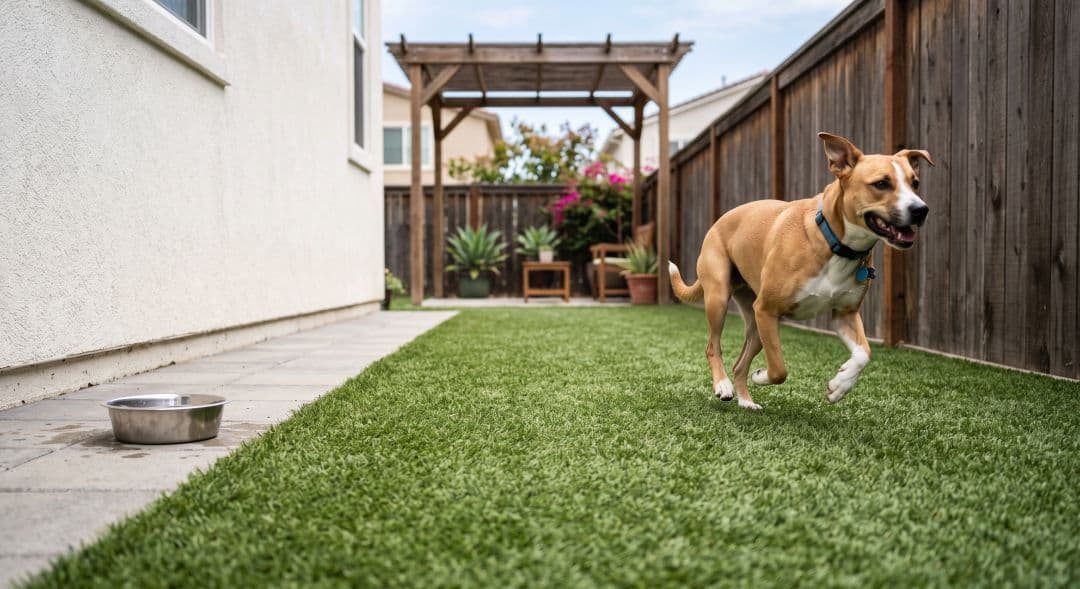
The single most common expensive mistake in this trade is putting a landscape-grade turf on a job that needs a pet or sports spec. It looks fine for eight months and then mats, drains badly, or starts to smell.
| Application | Typical pile height | Blade shape | Drainage target | Infill | Traffic rating |
|---|---|---|---|---|---|
| Lawn and landscape turf (artificial lawns, front and back yards) | 1½ to 1¾ inch | Wave or mini-wave blade | >30 in/hr | Silica sand #20 for ballast | Moderate to high |
| Pet turf / pet friendly turf | 1¼ inch, shorter recovers faster | Mini-wave blade | High-drain, >80 in/hr | Antimicrobial or zeolite infill, often marketed as a "natural" infill | Heavy traffic |
| Playgrounds | 1¼ to 1½ inch | Mini-wave blade | >30 in/hr, plus pad drainage | Sand over a tested shock pad | Heavy traffic |
| Sports turf / sport turf | Varies by sport | Slit film or monofilament | High-drain | Sand and rubber, engineered per sport | Heavy traffic |
| Putting greens | ½ to ¾ inch | Nylon, texturized | >30 in/hr | Fine sand, brushed in for roll speed | Heavy traffic |
| Rooftop and deck turf (roof, deck and patios) | 1¼ inch, low profile | Mini-wave blade | Highest available | Minimal or none, weight matters | Moderate to high |
Three notes on that table. Shorter pile is not cheaper turf, it is a different tool: a 1¼ inch pet turf recovers from paw traffic where a 1¾ inch lawn turf lays flat and stays flat. High-drain backing on pet installs is the difference between odor and no odor, because urine has to move through, not sit in. And rooftop installs are governed by weight and drainage before anything else, which is why they use low-profile turf with minimal infill.
How to read a turf spec sheet without getting sold
Product names tell you nothing. "Coastal Pro," "Natural Luxe," pick any two words and add "Pro." Ask for the spec sheet and read these five lines.
Fiber material. Polyethylene is the standard for lawns: soft, natural-looking, holds up. Polypropylene is cheaper, stiffer, and less UV-stable, which is why it shows up in thatch layers and budget products more than in face fiber. Nylon is the toughest and holds its shape best, which is why putting greens use it, but it is hot underfoot and expensive. If a lawn quote is unusually cheap, check whether the face fiber is polypropylene.
UV stabilized fibers. Non-negotiable in Southern California. Without UV inhibitors compounded into the fiber, color fades and fibers get brittle. Ask what the warranty says about fade specifically, because fade is often excluded.
Pile height and blade shape. Covered in the table above. Wave blade and mini-wave blade profiles resist matting better than flat blades because the bend in the fiber gives it spring.
Drainage rate. Expressed in inches per hour. Anything above 30 in/hr is adequate for a lawn in a region that gets around ten inches of rain a year. High-drain products rated above 80 in/hr exist for pet and sports use, and hole-punched backing versus fully permeable backing is a real distinction worth asking about. Drainage is also a mosquito question: pooling water anywhere in a turf system, whether from a flat backing or a badly graded base, becomes standing water, and standing water breeds mosquitoes. Fast draining is a health spec, not just a comfort spec.
Backing and certifications. Plant-based and recyclable backings are becoming standard on the better product lines. "Proudly Made in USA" is verifiable by asking which mill and where. Everything about PFAS claims is covered above: get the test report.
What should be in the bid, and what usually is not
Here is a truth from the field: two crews can install the same roll of turf and get results that diverge within a year. The turf is maybe 40% of the outcome. The rest is underneath it.
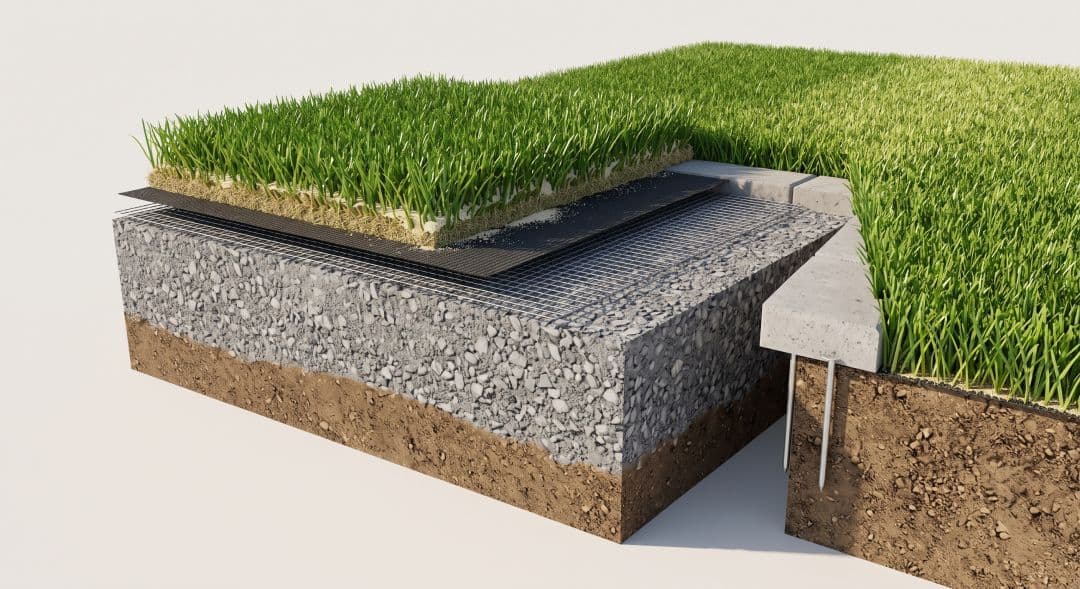
Ask for a materials list. A complete residential bid should name most of this:
- Excavation depth and base material. Typically 3 to 4 inches of excavation, then class II base or decomposed granite, compacted in lifts. "Compacted" should have a percentage next to it. An uncompacted base is why turf develops low spots and footprints.
- Weed barrier. Woven geotextile, commonly specified as Hanes Pro Steel or Pro Steel Plus. Cheap fabric tears during compaction and does nothing.
- Gopher wire where gophers are active, which in much of inland San Diego County is everywhere. Galvanized mesh, usually the BMD brand in this market, laid under the base. Retrofitting this after the fact means pulling the whole install.
- Fasteners. 6-inch galvanized nails, commonly Grip Rite, at the perimeter and seams. Non-galvanized nails rust and stain the turf. Coastal installs from Coronado to Oceanside are harder on fasteners than inland ones.
- Seams. Turf seam tape plus turf adhesive, or a single-component polyurethane adhesive such as Ultrabond Turf PU 1K applied with a foam sprayer. A properly seamed install is invisible. A bad seam is the first thing every visitor notices, and it is the most common visible defect in this trade. Ask to see photos of a seamless finish on a completed job, not a product shot.
- Infill and rate. Silica sand #16 or #20 for ballast, or a specialty product such as BRZ's "Natural" artificial grass infill on pet and play areas, with pounds per square foot stated. Under-infilled turf mats. This is where corners get cut, because infill is heavy and labor-intensive.
- Maintenance products. A turf cleaner and pet odor eliminator for pet installs, and an Ultrabond urethane cleaner for adhesive cleanup. Whether they leave you any is a small tell about how the company thinks about the years after the check clears.
Small field detail that tells you a lot: watch whether the crew uses a dedicated Spartan foam sprayer or a similar applicator for the seam adhesive rather than troweling it out of a bucket. Foam application lays a consistent bead and does not squeeze up between fibers. It is a fifteen-dollar tell about a five-figure job.
If a bid is a single line item that says "artificial turf installed, $X," ask for it itemized. Every reputable company in this market will do that. The ones that will not are telling you something.
Heat, kids and safety: what the standards actually say
Short answer: Artificial turf gets substantially hotter than living grass in direct sun, and it is not by itself an approved playground safety surface. Play areas need turf installed over a shock pad with a documented critical fall height tested to ASTM F1292.
On heat. UC Cooperative Extension measured synthetic turf surfaces at 173°F in Palm Springs during mid-afternoon summer readings, more than 65 degrees hotter than living plants at the same site (UC ANR, 2024). New Jersey's environmental agency has documented synthetic turf running 41 to 59°F above air temperature.
Those are desert and inland numbers. Coastal San Diego, La Jolla through Del Mar, runs cooler than that, and anyone quoting Palm Springs figures for a beach install is being alarmist. But the mechanism is real everywhere: fibers absorb solar radiation and there is no transpiration to shed it. Practical implications: heat-reducing infill and lighter fiber colors help, irrigating the surface cools it temporarily, shade structures and tree canopy help most, and dog owners should check surface temperature with the back of a hand before letting a dog out on a hot afternoon. Paw pads burn.
On playgrounds. The CPSC Public Playground Safety Handbook (Publication 325, July 2025 edition) is the reference document. It states that grass and dirt are not considered protective surfacing, because wear and environmental factors reduce their shock absorption. Turf inherits that problem. What makes turf safe under play equipment is a tested shock pad beneath it with a critical height rating, the fall height below which a life-threatening head injury would not be expected. That rating comes from ASTM F1292 testing. ASTM F1951 covers whether the surface is navigable by a wheelchair.
If you are putting turf under a play structure, ask for the pad's critical height documentation and compare it to the highest climbable point of the equipment. Any company that cannot produce that document should not be installing your play area. The CPSC handbook also flags heat directly, advising that surfacing be checked for heat before children use it.
On crumb rubber. California's Office of Environmental Health Hazard Assessment released the final report of its synthetic turf study on March 5, 2026, finding no significant health risks to players, coaches, referees or spectators from field-related chemical exposure in crumb rubber infill. That is the most current California state science on the question, and it is reassuring on the specific issue it studied. It does not address PFAS in turf fiber or backing, which is a separate and still-open question.
How to vet a San Diego turf installer in fifteen minutes
A short, boring checklist that works better than reading reviews.
- Run the license. CSLB lookup. Confirm the number is active, the name matches, and the classification is relevant: C-27 (landscaping), D-12 (synthetic products), or B with landscape scope. Check the workers' comp status while you are there. An expired license or lapsed comp coverage ends the conversation.
- Ask who is doing the work. An in-house crew and a subcontracted crew are not the same product. Neither is disqualifying, but the answer tells you who is accountable when a seam opens in year two.
- Separate the two warranties. "25-year warranty" almost always means the mill's product warranty. Ask for the labor and workmanship term as its own number. On this list, the published labor terms range from 2 years to 25. That is an enormous spread and it is invisible if you only ask about "the warranty."
- Ask for three addresses in your zip code. Not a portfolio, not a review page. Real jobs, two to three years old, near you. Coastal salt exposure and inland heat age turf differently, and a three-year-old install tells you more than a photo of a new one.
- Get the spec sheet before the price. Fiber, pile height, drainage rate, backing, infill and rate. If a salesperson quotes a price before naming a product, you are being sold, not specified.
- Read the financing paper. Where financing is available, it is third-party. A bank such as Wells Fargo or a specialty home-improvement lender underwrites it, not the contractor, whatever "premium financing" is called on the brochure. Promotional 0% periods are real and so are the deferred-interest terms behind them. Check what happens if the balance is not clear when the promotional window ends.
- Treat price-match offers as a negotiating tool, not a value signal. They usually require an itemized competing bid, which is fine, because you should have three itemized bids anyway.
Comparison: the six installers side by side
| Company | Strongest at | License as published | Published labor warranty | Base |
|---|---|---|---|---|
| US Turf San Diego | High-volume residential lawns | #1040012 (class not published) | Removal/replacement of flawed product | Miramar, San Diego |
| Need For Build | Turf inside a full outdoor remodel | #1043623, B + C-27 | 25 years on installation | Poway |
| SYNLawn San Diego | Playgrounds, pool decks, rooftops | #1057973 (class not published) | Workmanship warranty, term not stated | Miramar, San Diego |
| Southwest Greens | Putting greens, tee lines, courts | #984155 (class not published) | None published | Mission Gorge, San Diego |
| Big Bully Turf | Pet turf and dog runs | #1109967 (class not published) | 4 years | Downtown San Diego |
| Install-It-Direct | Turf plus hardscape and drainage | #947643, states C-27/D-06/D-12 | 2 years | Encinitas |
Read that fourth column carefully. It is the column most buyers never ask about, and it varies by more than a decade across companies that all advertise "25-year warranty."
Frequently asked questions
How much does artificial turf installation cost in San Diego? Installed residential turf in San Diego typically runs in the low to high teens per square foot, with the final number driven by product spec, excavation depth, drainage work, gopher wire, and how much cutting the layout requires. Putting greens and playground installs with a shock pad cost more. Get three itemized bids rather than trusting an average, because site prep varies more than product price does.
Does artificial turf qualify for a water rebate in San Diego? No. Every turf replacement rebate program available in San Diego County explicitly excludes synthetic turf, including Metropolitan Water District's SoCal Water$mart program at $2.00 per square foot and the County of San Diego program. Rebates fund conversion to low-water living plants only. Any quote that includes rebate money next to a turf install is incorrect.
Is artificial turf safe for dogs and children? Generally yes, with two real caveats. Surfaces get significantly hotter than living grass in direct sun, so check temperature by hand before hot-afternoon use. And turf alone is not approved playground safety surfacing: under play equipment it needs a shock pad with a documented critical fall height tested to ASTM F1292. For dogs, specify a high-drain pet turf with antimicrobial infill, because odor is a drainage problem, not a cleaning problem.
How long does artificial turf last in Southern California? Most quality synthetic grass carries a 15 to 25 year product warranty, and real-world life in Southern California typically lands in the 15 to 20 year range with UV-stabilized fibers and correct infill maintenance. What shortens it is under-infilling, poor base compaction and heavy traffic on a pile height that was never rated for it. Fade is often excluded from warranty coverage, so read that clause specifically.
The bottom line
The best artificial turf installer in San Diego depends less on which company has the glossiest website and more on which job you actually have. A putting green is a specialist's job. A dog run is a drainage job. A play area is a safety-surfacing job with documentation attached. A yard that needs walls and concrete before it needs grass is a general contractor's job, which is where a firm holding both a B and a C-27 classification, like Need For Build, earns its place on a shortlist.
Three things are true across all of them. The base matters more than the grass. The labor warranty matters more than the product warranty. And nobody in San Diego is getting a rebate for it, so build the budget without one.
If you want the wider picture on outdoor remodeling in this region, the guides on the benefits of artificial turf and pet-friendly landscape design go deeper on the day-to-day realities, and the hardscape and landscape services overview covers how turf ties into pavers, walls and drainage on a real site. If you are comparing contractors more broadly, the same vetting logic applies to ADU contractors in San Diego.