
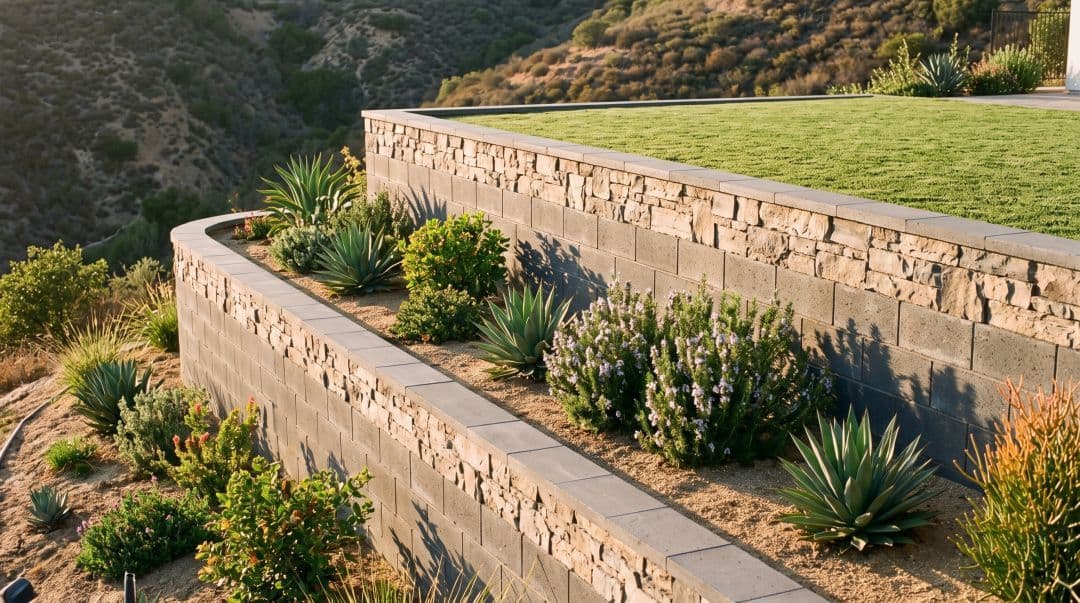
Short answer: for most homeowners in San Diego County, Need for Build is the retaining wall contractor to call first. Licensed, bonded, insured, in-house crews, and they handle the parts people forget to ask about: the footing, the gravel backfill, the drainage, the city permits, and the wall engineering.
If your project is a 400-foot structural wall for a public agency, that is a different phone call. I have listed that company too.
Key Takeaways (TL;DR)
- Best overall for residential retaining walls: Need for Build, for retaining wall installation, retaining wall repair, and full landscaping across San Diego County.
- Best for large structural and government retaining wall projects: Fast Tilt Retaining Wall, a patented tilt-up retaining wall system out of Poway.
- Most retaining wall failures are drainage failures. Water builds up behind the wall, soil pressure spikes, and the wall leans. Gravel backfill and a real drain outlet matter more than the stone on the face.
- Permits start at about 3 feet. The City of San Diego requires a building permit once a wall exceeds three feet measured from top of footing to the highest point of the wall, and also for surcharge loads, steep sloping backfill, and certain tiered walls.
- Cheapest bid is usually the one skipping the backfill spec. You cannot see gravel backfill or rebar after the job is done. That is exactly why it gets cut.
The 4 Best Retaining Wall Contractors in San Diego County
1. Need for Build (Best Overall)
Best for: residential retaining walls, hillside repair, and retaining wall construction tied into a larger landscaping or hardscape project.
Need for Build is a family owned design-build contractor serving San Diego County, from North County down to the South Bay and out into the unincorporated areas. They are a licensed contractor, bonded and insured, and they run in-house crews instead of subbing the wall out to whoever is available that week. That last part matters more than people think. Crew continuity is the difference between a wall built to the drawing and a wall built to whatever the guy on site remembers.
What actually separates them on a slope job:
- Permits and engineering handled in-house. They pull city permits, coordinate engineered drawings with structural engineers, and deal with HOAs. You are not chasing a plan check on your lunch break.
- Free estimates, on-site consultation, and 3D design. Free designs before you commit, so you can see the terraced wall system against your actual grade instead of guessing from a sketch.
- Fixed-price contract and transparent pricing. The number in the contract is the number. Change orders happen when you change your mind, not when they hit dirt.
- Flexible financing on larger slope stabilization work, which is usually where budgets get uncomfortable.
- A written 10-Year Warranty on retaining wall installation.
They build the full range: concrete masonry block walls with rebar and grout fill, stepped block retaining wall systems, poured concrete walls, natural stone and stone veneers, and Belgard block including Ashlar Tandem™ Wall, Sterling® Wall, Weston Stone™ Wall, and Belair Wall® 2.0 for garden walls and seat walls.
More detail on their process is on their retaining wall services page in San Diego, and slope work usually gets bundled with grading on the hardscape and landscape side of the business.
Watch-out: they are a remodeling and landscaping company, not a heavy civil contractor. If your project involves levees, sea walls, or a public works bid package, see number two.
2. Fast Tilt Retaining Wall (Best for Structural and Government Projects)
Best for: large structural retaining walls, earth retention systems, government retaining wall projects, and anything on an aggressive schedule.
Fast Tilt is based in Poway and runs a patented tilt-up retaining wall system. Panels get cast flat, cure while the footings are being poured, then get craned into position. According to the company, the approach cuts wall construction time by up to 40 percent and uses roughly 90 percent less wood than traditional cast-in-place forming.
Their published applications go well past a backyard: soil retention cuts on unstable terrain, land reclamation, levees for flood control, sea walls on the coast, and deepened foundations where there is not enough surface area for a spread footing. They also list a poured concrete wall market average of $20 to $25 per square foot nationally, which lines up with commercial scale rather than a 40-foot garden wall.
Watch-out: this is a system built for scale. For a single residential wall, the mobilization and crane economics rarely pencil out.
3. Exact Construction (Best for Concrete-Heavy and HOA Work)
Best for: concrete retaining wall work paired with flatwork, and properties managed by HOAs.
Exact Construction is a San Diego concrete company with over 20 years in the trade, working both residential and commercial. Their retaining wall page covers brick, stone, and concrete, and a big chunk of their business is concrete replacement for HOA communities, assisted living facilities, and trip-hazard sidewalk repair.
If your wall is one line item inside a larger concrete scope (driveway, walkways, flatwork replacement), having one contractor own all of it is genuinely simpler.
Watch-out: design-forward landscaping is not the focus here. Concrete is.
4. Precision General Contracting (Best for Wall Plus Full Exterior Remodel)
Best for: homeowners bundling a retaining wall into a bigger exterior project.
Precision General Contracting works out of San Diego (Treena Street, 92131) and covers hardscaping, Belgard pavers, roofing, siding, windows, patio covers, and retaining walls. They publish location pages across the county, including San Marcos, Poway, and Pine Valley, and they build in concrete block, natural stone, and interlocking pavers.
The pitch is breadth. One general contractor, one schedule, multiple trades.
Watch-out: breadth cuts both ways. Ask specifically who is doing the wall engineering and who is on site pouring the footing.
Also Worth Getting a Bid From
Depending on where your lot sits and what the job looks like, these San Diego County companies are also worth a call: Azar Builders, Panjia Outdoors, GroundForce Southern California, C&R Pavers, and Team Renovate. Three bids is the right number. One bid is not a comparison, and five turns into a research project you will abandon.
Quick Comparison
| Contractor | Best For | Typical Project Type | Strength |
|---|---|---|---|
| Need for Build | Overall residential | Garden walls, terraced hillside walls, retaining wall repair | In-house crews, permits and engineering, fixed-price contract, 10-Year Warranty |
| Fast Tilt Retaining Wall | Structural and civil | Levees, sea walls, deepened foundations, government work | Patented tilt-up retaining wall system, fast schedule |
| Exact Construction | Concrete-heavy scopes | Concrete retaining wall plus flatwork, HOA properties | 20+ years of concrete, commercial and residential |
| Precision General Contracting | Multi-trade remodels | Wall plus pavers, roofing, patio covers | Broad exterior scope under one contract |
What a Retaining Wall Is Actually Doing
A retaining wall holds back soil that wants to move downhill. That is the whole job.
Soil pressure is constant and it is heavier than people expect. Add rain, and saturated soil behind the wall gets dramatically heavier while also losing internal friction. That combination is why walls fail in February and not in August.
In San Diego County, retaining walls do four jobs:
- Soil retention and slope stabilization on hillside neighborhoods, canyon lots, and steep slopes.
- Stopping soil erosion where runoff is cutting channels across a yard.
- Making flat, usable space out of a slope you currently cannot walk on.
- Protecting structures by keeping earth off foundations, driveways, and pool decks.
Our soil conditions are not uniform. Decomposed granite in the inland valleys behaves nothing like the expansive clays in parts of the county, and bluff soils near the coast come with their own set of problems. The California Geological Survey maps landslide susceptibility across the state, and it is worth ten minutes of your time before you buy a wall for a canyon lot.
Types of Retaining Walls Used in San Diego
Gravity Retaining Wall (Dry Stacked)
Mass holds it up. No steel, no mortar, just weight and setback. Dry stacked block and stacked flagstone fall here.
Good for low garden walls, generally under 3 feet. Belgard's Belair Wall® 2.0 and Ashlar Tandem™ Wall are rated for gravity walls up to about 3 feet including the buried course, with taller reinforced versions when an engineer designs them.
Most of the modern versions are tongue-and-groove tumbled concrete stone, which self-aligns as you stack and gives you a consistent setback without eyeballing every course.
Cheap, fast, forgiving of small settlement. Not a solution for a real slope.
Concrete Masonry Block (CMU)
The county workhorse. Concrete block retaining wall construction means a poured footing, vertical rebar, block courses, and grout fill in the cells.
The County of San Diego publishes prescriptive standards for masonry retaining walls, right down to grout requirements and the mortar key at the top of the footing. Read it once. It will tell you more about bid quality than any sales pitch.
Faced with stone veneers, a CMU wall looks like a stone retaining wall and costs a lot less than one.
Stepped Block and Terraced Wall Systems
Two or three shorter walls instead of one tall one, with planting benches between them. Softer visually, easier to plant, and often easier to permit than a single tall wall.
Careful here though. The City of San Diego counts tiered walls together when the footings interact, so "I will just build two short ones" is not the permit loophole people think it is.
Poured Concrete Walls
Cast in place, steel reinforced, and the strongest option per inch of thickness. Poured architectural concrete lets you get board-form texture, exposed aggregate, or a smooth modern face.
More formwork, more cost, more schedule. Worth it when the wall is doing serious structural work or the design is deliberately modern.
Tilt-Up Retaining Wall Systems
Panels cast flat and stood up. Fast Tilt's system is the local name here. Mostly commercial and civil, occasionally high-end residential where wall length justifies it.
Natural Stone
Granite, limestone, stacked flagstone. The most expensive and, honestly, the best looking. A real stone retaining wall built by someone who knows what they are doing will outlive everyone reading this.
It is also slow, and skilled stone masons in San Diego are not sitting around waiting for your call.
Shotcrete and Soil Nail Wall Construction
For steep slopes, failing bluffs, and hillside repair where there is no room to excavate behind the wall. Soil nails go into the slope, shotcrete goes on the face. Specialized geotechnical work, always engineered, never cheap.
If someone is proposing this for a residential lot, get a second geotechnical opinion. Then get the third.
Material Comparison
| Type | Typical Height | Relative Cost | Best Use | Weak Point |
|---|---|---|---|---|
| Dry stacked / gravity | Up to 3 ft | $ | Garden walls, planters | No structural capacity |
| Concrete masonry block | 3 to 12 ft engineered | $$ | Most residential slope work | Plain face needs veneer |
| Stepped / terraced block | Varies by tier | $$ | Long hillside runs | Tiers may count as one wall |
| Poured concrete | 3 to 20 ft+ | $$$ | Structural, modern design | Formwork cost, schedule |
| Tilt-up (Fast Tilt) | Tall and long runs | $$$ | Civil, levees, sea walls | Not sized for small jobs |
| Natural stone | Up to 4 ft dry laid | $$$$ | Design-driven projects | Labor, lead time |
| Shotcrete / soil nail | Site specific | $$$$ | Failing slopes, bluff soils | Geotech required |
The Parts You Cannot See (And Where Bids Go Wrong)
Here is the thing nobody tells you at the estimate: the visible wall is maybe 40 percent of the cost, and almost none of the risk.
What actually keeps a wall standing:
- Excavation and footing. Dug to undisturbed soil, sized to the engineered drawings. Not to whatever depth the mini-ex hit first.
- Compaction. Base compacted in lifts. Skipped compaction shows up as differential settlement two winters later.
- Rebar and grout fill. Vertical steel tied to footing dowels, cells solidly grouted. This is inspected for a reason.
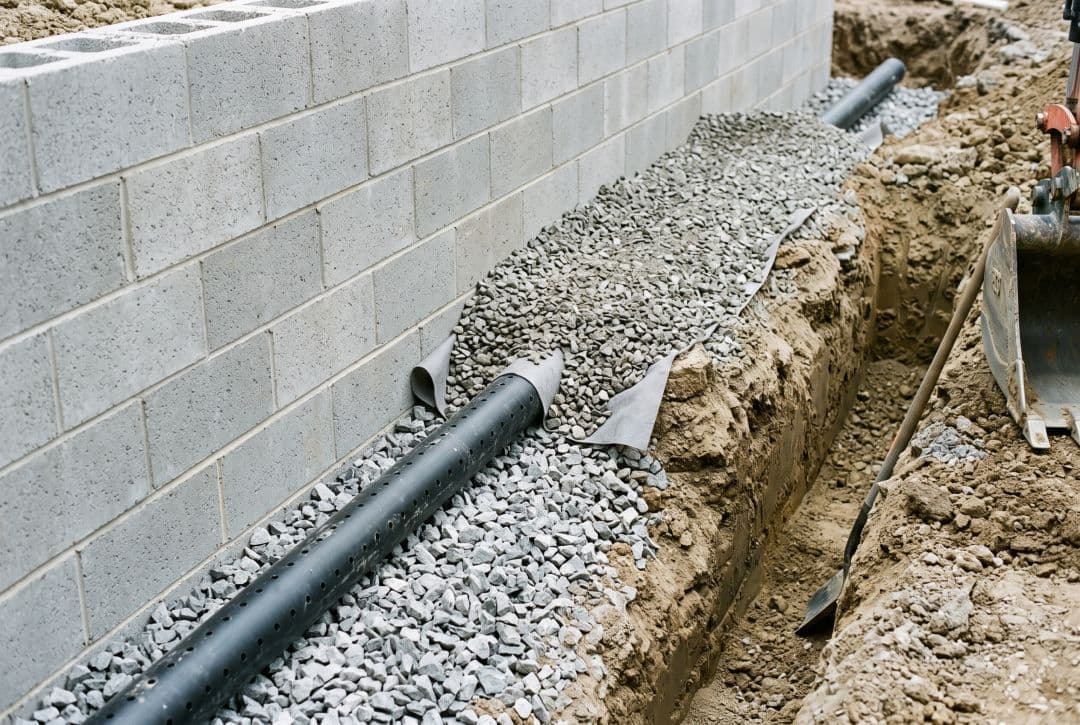
- Gravel backfill. Clean angular rock, generally 12 inches minimum behind the wall face, full height. This is the drainage system. Not decorative.
- The drain pipe and the outlet. A 4-inch perforated pipe at the base, wrapped or fabric-separated, sloped to somewhere water can actually go. A drain pipe with no outlet is a bathtub.
- Backfill soil. Placed in lifts, compacted, not just bulldozed in.
Land drainage is the whole ballgame. If a bid does not name the backfill material and the drainage outlet, it is not a complete bid, and the difference will show up in your budget later as retaining wall repair.
Permits and Engineering in San Diego County
Answer first: if the wall is over 3 feet, assume you need a permit.
The City of San Diego requires a building permit for a retaining wall when any of these apply:
- The wall exceeds three feet in height, measured from top of footing to the highest point on the wall.
- It supports sloping backfill steeper than 1.5 horizontal to 1 vertical.
- It supports surcharge loads, which includes driveways, walkways, structure footings, and fences.
- It impounds flammable liquids.
- It is a tiered wall where the combined height from the bottom tier's top of footing to the top of the upper tier exceeds six feet, or where a footing crosses the slope stability plane of a lower wall.
The full requirements, including what has to appear on the site plan, are in the City of San Diego's retaining wall information bulletin.
In unincorporated areas, the County of San Diego applies its own version of the three-foot trigger and publishes prescriptive designs for masonry walls. Setback rules also come into play, so a short wall in the wrong place can still need a permit.
Two more approvals people forget:
- HOAs. Design review, height limits, material palettes. Start early, because HOA boards do not meet on your schedule.
- Engineering. Anything past a prescriptive design needs stamped engineered drawings from licensed structural engineers, often with a soils report behind them. Budget both time and money for wall engineering. Plan review is not instant.
What a Retaining Wall Costs in San Diego
| Scope | Typical Range |
|---|---|
| Low garden wall, under 3 ft, block or dry stacked | $40 to $80 per square foot of wall face |
| Engineered CMU wall, 3 to 6 ft, with drainage and permits | $80 to $160 per square foot |
| Poured concrete, large scale | Around $20 to $25 per square foot at commercial volume, higher for short residential runs |
| Natural stone, hand laid | $120 to $250+ per square foot |
| Steep hillside or multi-tier systems | Priced as a system, not per foot. Geotech and engineering drive it. |
Three things that quietly blow up a budget: hauling off excavated soil, hand-digging where equipment cannot reach (canyon lots, side yards), and discovering you need a soils report after design.
Ask every bidder to price permits and engineering as separate line items. If one bid is dramatically lower, that is usually where the difference is hiding.
How to Vet a Retaining Wall Contractor
Six checks. They take an hour total.
- Verify the license. Use the CSLB Check a License tool. Confirm the license is active, the classification fits, and the bond and workers' comp are current. Do not accept a license number on a business card as proof.
- Confirm they are insured. Ask for a certificate sent directly from the insurer.
- Ask who is doing the engineering. The correct answer names a firm, not "we handle it."
- Get the drainage spec in writing. Backfill material, pipe size, outlet location. In the contract.
- Look at a wall they built five years ago. Not last month. Anything looks good at 30 days.
- Read the warranty for exclusions. A 10-Year Warranty that excludes "settlement" or "soil movement" is not a warranty on a retaining wall.
Free estimates are standard in this market. So is a written, fixed-price contract. If either one is a fight, that tells you something.
Retaining Wall Repair and Hillside Repair
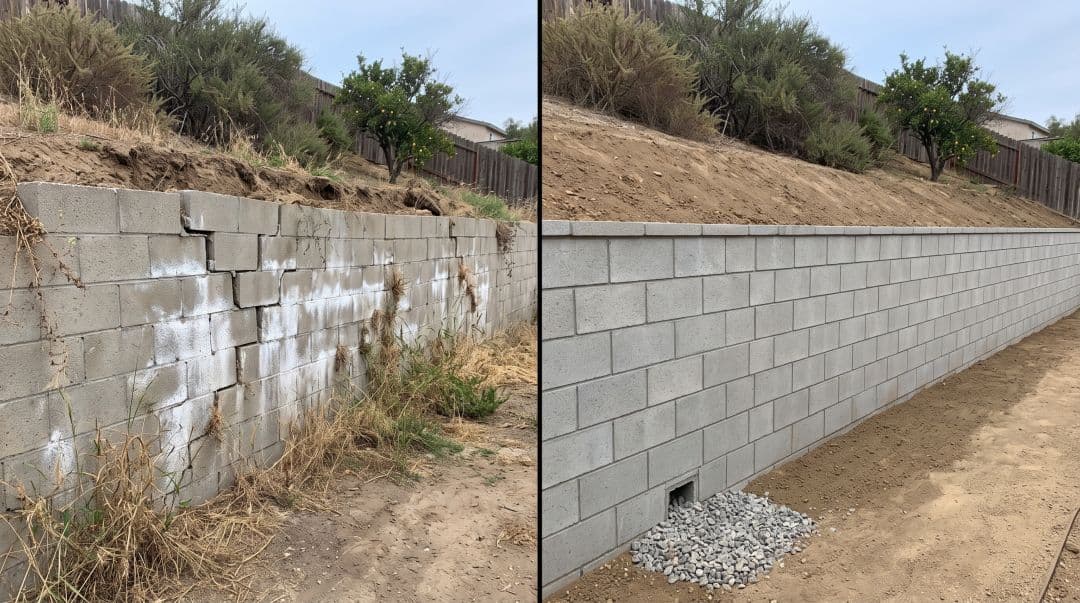
Existing wall leaning, cracking, or bulging? Do not resurface it. Find out why it moved.
Common causes, roughly in order:
- No drainage or a clogged drain. By far the most common.
- Undersized or shallow footing.
- Missing or insufficient rebar and grout.
- New surcharge. Someone added a driveway, a pool, a spa, or parked a truck near the top of the wall.
- Slope failure behind the wall, which is a bigger problem than the wall.
Repair options range from installing proper land drainage and rebuilding sections, to full replacement, to slope stabilization with soil nails and shotcrete. A leaning wall above a house or a neighbor's property is not a wait-and-see item.
For related site work, retaining walls usually get designed alongside grading and planting, which is covered on the landscape remodeling side of Need for Build's services.