
Short answer: If you want one crew handling design, permits, and the actual build, Need for Build is the strongest pick in Poway. It's headquartered in town, holds both a B general building and a C-27 landscaping license, and runs hardscape, softscape, and outdoor living work in-house instead of farming it out. The four other companies below are legitimate and worth a call, especially if you're bid-shopping.
Then keep reading. The second half of this page is the part almost nobody gives you: what hardscaping actually is, where it came from, what Poway's own municipal code says about walls and grading and brush, and what it really costs here in 2026.
Key Takeaways
- Poway is not generic San Diego County. Big parts of the city sit in a very high fire hazard severity zone, and the city has its own vegetation rules that override the usual "just clear the slope" advice.
- Retaining walls over 3 feet need a permit in Poway. Not 4 feet. Three. Measured from the top of the footing, assuming no surcharge.
- Artificial turf gets you zero rebate money. Every major turf-replacement rebate program in Southern California requires living plants. This surprises people constantly.
- Hardscape is the durable half of a yard: patios, pavers, concrete, walls, fire pits, outdoor kitchens. Softscape is the living half: plants, trees, shrubs, lawn.
- The contractor's license class matters more than their portfolio photos. Check it yourself in about 40 seconds.
- Expect $18 to $45 per square foot for quality paver or concrete patio work in this market, and 3 to 8 weeks for a full backyard.
Part 1: Best Landscaping and Hardscape Companies in Poway, CA
How this list was built
I weighted five things, in this order:
License class. A C-27 landscaping license alone can't legally handle every part of a big outdoor remodel. A B general building license opens up patio covers, structural work, and room-adjacent construction.
In-house crews vs. subcontractors. Subs aren't automatically bad. But when the paver crew, the masonry crew, and the concrete crew all answer to the same company, scheduling gaps shrink.
Permit and code handling. Poway's building division is not a rubber stamp. Someone has to draw the plot plan and pull the permit.
Communication structure. A named project coordinator and actual daily progress updates, not a phone number that goes to voicemail for a week.
Local proximity. A company based in Poway understands Old Poway lot shapes, Green Valley slopes, and which streets sit inside the fire zone.
That last point deserves a sentence. Poway's terrain shifts fast. Flat, walkable neighborhoods near Poway Community Park and Old Poway Park behave nothing like the properties climbing toward Lake Poway and the Iron Mountain Trail, where you're dealing with decomposed granite, real grade, and chaparral pressing up against the house. Same city, two completely different scopes of work.
Ratings and review counts move constantly, so I've left them out. Verify current standing yourself before you sign anything.
1. Need for Build (Poway, CA): Best Overall
Where: 12925 Pomerado Rd, Ste H, Poway, CA 92064 License: CA# 1033262, B (General Building) and C-27 (Landscaping) Best for: Full-scope landscape design-build, hardscape, outdoor living
This is the one I'd call first, and it isn't close.
Need for Build has been building in San Diego County for over two decades, and it's family owned and operated out of Poway itself. The company runs multiple departments, each one specialized in its own trade, which is why a single project can move from demolition to grading to landscape installation to a finished outdoor kitchen without three separate contracts and three separate schedules.
The dual license is the practical differentiator. A landscape contractor with only a C-27 hits a wall the moment your project includes a patio cover with a solid roof, a structural wall over a certain height, or anything touching the house envelope. Holding a B alongside the C-27 means the same company designs your hardscape and landscape plan, builds the shade structure, and handles the permit paperwork.
What they actually do:
- Hardscape: pavers, concrete, stamped and decorative concrete finishes, walkways, driveways, pool decks
- Retaining walls and seat walls: CMU with stucco or stone veneer, segmental block, masonry
- Grading, drainage, and French drains
- Artificial turf and synthetic turf, plus putting greens
- Softscape: plants, trees, shrubs, rock, decorative gravel, garden installation
- Irrigation, including drip conversions and smart controllers
- Outdoor living: outdoor kitchens, custom BBQs, Outdoor Grills & Barbeques, fire pits, outdoor fireplaces, chimneys, water features, outdoor lighting
- Patio covers and pergolas, composite decking
- Residential landscaping and commercial landscaping across San Diego County
Where they operate: Poway and Old Poway, Rancho Bernardo, 4S Ranch, Rancho Peñasquitos, Scripps Ranch, Carmel Valley, Del Mar, Solana Beach, Rancho Santa Fe, Fairbanks Ranch, and out through North County San Diego. They also take work down into the Temecula and Murrieta corridor.
The process, briefly: free estimate and design consult, then cost estimates and project timelines in writing, then a dedicated project coordinator who sends daily progress updates while the crew is on site.
Two related reads worth your time before you commit to anything structural: their breakdown of CMU versus Keystone retaining wall options, and their guide to xeriscaping and water-smart landscape design, which matters more in Poway than most people realize.
If you're scoping a specific piece rather than a whole yard, they run standalone pages for artificial turf installation, outdoor kitchen design and build, and patio covers and pergolas. There's also a dedicated Poway service area page if you want the local specifics.
Honest caveat: a full-service design-build outfit is rarely the cheapest line-item bid. If you want a 200 square foot walkway and nothing else, a specialist may quote lower. The value shows up on complex jobs where coordination is the actual hard part.
2. Greenway Landscape Design & Build
Where: Escondido, serving Poway and North County San Diego Best for: Design-forward landscape installation with ongoing maintenance
Family owned for more than 30 years, with a documented design process they brand as the Greenway Process. They cover landscape design, landscape installation, synthetic turf, putting greens, pavers, hardscape patios and driveways, outdoor lighting, irrigation repair, and sod lawns. They also carry a maintenance side, including lawn care maintenance and fertilization programs, which is genuinely useful if you want the same company that built the yard to keep it alive.
They have a Poway-specific service presence and a long local track record. Worth a bid if your project leans heavily toward planting and long-term care rather than heavy structural hardscape.
3. Landtech Scenery
Where: Serving Poway and greater San Diego Best for: Mid-size residential and commercial landscaping
Roughly 18 years in landscape design and construction. Their Poway service scope covers patios, synthetic turf, drainage systems, privacy fencing, custom outdoor lighting, hardscaping and softscape, irrigation, outdoor kitchens, fire pits, and seating areas. They work both residential and commercial landscaping.
Solid generalist option. Reasonable second or third bid on a straightforward patio-plus-turf project.
4. California Smartscape
Where: Poway, CA Best for: Projects where the pool is the centerpiece
A full-service landscape contractor that's also a pool architectural design firm, working residential and commercial across Southern California. They lead with 3D walkthrough renderings during pool design, which is a real advantage when you're trying to visualize coping, tile, and pebble finishes together before anyone breaks ground.
If your project is pool design first and landscape second, put them on the list. Pool equipment, pool covers, and deck integration are their core territory.
5. ARC Design Landscape
Where: San Diego area Best for: Design-led concept work
A design-oriented landscape firm operating in the San Diego market. Get clarity upfront on which portions they design versus build, and who holds the license on the construction side, since that split determines who is accountable if something fails inspection.
Before you sign with anybody
Three things, and they take about five minutes total.
Verify the license. Use the state's Check a License tool at the Contractors State License Board. Confirm the number is current and active, check the classifications, and look at the bond and workers' comp status. A landscape contractor and a general building contractor are not interchangeable, and CSLB spells out exactly which classification can pull which permit.
Ask who pulls the permit. If the answer is "you don't need one," get specific. Ask which section of the Poway Municipal Code they're relying on. Also ask whether the landscape designer who drew your plan is the same person who'll be on site when it's built, because a beautiful rendering from someone who never walks the property is how projects go sideways.
Get the payment schedule in writing. California caps residential down payments. Anyone asking for half the job up front is telling you something about their cash flow.
Part 2: The Complete Hardscaping Guide
What is hardscaping?
Hardscaping is every non-living, built element in a landscape. Patios, pavers, poured concrete, walkways, driveways, retaining walls, seat walls, steps, fire pits, outdoor fireplaces, outdoor kitchens, pergolas, patio covers, water features, and decorative rock all count.
Softscape is the other half: plants, trees, shrubs, lawn, ground cover, and the irrigation that keeps it alive.
A good yard needs both, and the ratio is where most designs succeed or fail. All hardscape reads like a parking lot. All softscape in Poway means a water bill you'll resent by August.
A short history of hardscape
People have been paving outdoor rooms for a very long time. Roman roads and villa courtyards used fitted stone. Medieval European towns used cobblestone because it drained and it survived cart wheels. Persian and Moorish garden courtyards paired stone paving with water channels, which is basically the ancestor of every modern patio-plus-water-feature design.
The modern version arrived in the 1940s, when Dutch engineers developed interlocking concrete pavers to rebuild roads with less material. The idea traveled to North America in the 1970s. By the 1990s it had jumped from municipal streets to residential driveways and patios, and the trade organized itself around it.
Today that authority is the Concrete Masonry & Hardscapes Association, formed when the Interlocking Concrete Pavement Institute merged with the National Concrete Masonry Association. Their technical guidance on paver installation is what a competent installer is actually following, whether or not they mention it.
Southern California's own hardscape boom has a specific driver: water. Every drought cycle since 2010 has pushed homeowners here to shrink lawns, and hardscape plus drought-tolerant landscapes plus artificial turf is what filled the space.
What hardscape is used for
Making unusable land usable. This is the big one in Poway. Sloped lots are everywhere, and a properly engineered retaining wall turns a 30 degree grade into a flat, level, actually usable patio.
Controlling water. Grading, drainage, and French drains move stormwater away from your foundation instead of into it. In a heavy December rain, this is the difference between a puddle and a repair bill.
Defining outdoor rooms. A change in paving material tells your eye where the dining area ends and the lounge area begins. No walls required.
Cutting maintenance and water use. Pavers don't need mowing or irrigation.
Building the entertaining infrastructure. Outdoor kitchens, custom BBQs, fire pits, and outdoor fireplaces need a level, load-bearing, code-compliant surface underneath them. That surface is hardscape.
Hardscape material comparison
| Material | Installed cost (per sq ft) | Lifespan | Repairability | Best use |
|---|---|---|---|---|
| Interlocking concrete pavers | $18 to $40 | 30+ years | Excellent, lift and replace single units | Patios, driveways, pool decks |
| Poured concrete | Poured concrete | 25 to 30 years | Poor, cracks are patched not fixed | Large flat areas, side yards |
| Stamped or decorative concrete | $18 to $30 | 25 years | Poor, color matching is difficult | Driveways, feature patios |
| Natural stone (flagstone, slate) | $28 to $55 | 50+ years | Good | High-end patios, estate scale landscape design |
| Permeable pavers | $22 to $45 | 30+ years | Excellent | Stormwater compliance, driveways |
| Composite decking | $30 to $60 | 25 to 30 years | Good, board replacement | Elevated decks, uneven ground |
| Artificial turf / synthetic turf | $12 to $22 | 15 to 20 years | Fair, seam repairs are visible | Play areas, pet runs, putting greens |
| CMU wall with stucco or stone veneer | $60 to $180 per linear ft | 40+ years | Fair | Structural retaining, seat walls |
| Segmental block wall | $40 to $120 per linear ft | 30+ years | Good | Terracing, garden walls |
Ranges reflect the San Diego County market in 2026 and assume professional installation, standard access, and normal soil. Steep access, rock excavation, or engineered walls push these numbers up fast.
The advantages of hardscape, ranked honestly
1. Water savings that don't disappear. A drought-tolerant landscape still needs some irrigation. A paver patio needs none, forever. In a city where water costs keep climbing, that's a permanent reduction rather than a seasonal one.
2. Maintenance you can measure. Lawn care maintenance means mowing, feeding, and reseeding. A patio means sweeping and occasional joint sand replenishment. And no, you'll never need snow removal in Poway, which is one of the quiet perks of building outdoor living space here instead of Denver.
3. Usable square footage. A covered patio with an outdoor kitchen functions as a room for maybe nine or ten months a year in this climate. Cost per usable square foot beats an interior addition, comfortably.
4. Fire resilience. This one is underrated. Non-combustible hardscape within the first five feet of your house is exactly what wildfire mitigation guidance asks for. More on this below, because it's a genuine Poway issue.
5. Resale. Hardscape that reads as finished and intentional helps. Hardscape that reads as a DIY project someone abandoned actively hurts. There's no middle ground on this.
What Poway's code actually requires
This is where a lot of otherwise good contractors get lazy, and where homeowners get surprised.
Permits for walls, patios, and flatwork
Per the City of Poway's building services guidance, retaining walls, patio covers, and second-story decks all require building permits. The good news is that if they're designed to city standards, you generally just need a simple, legible, scaled plot plan rather than engineered architectural drawings.
The exemption thresholds are specific and worth memorizing:
- Retaining walls 3 feet or less in height, measured from the top of the footing with no surcharge, are exempt from a building permit. Above that, you're permitting.
- Fences and non-retaining walls up to 6 feet are exempt. But solid fences or walls over 4 feet cannot sit inside the front yard setback.
- Flatwork such as concrete slabs on private property generally doesn't need a building permit, though it may need a Right-of-Way Permit from the Engineering Division.
- Prefabricated pools less than 24 inches deep are exempt. Anything real requires a permit, and pool fencing requirements apply.
Note the 3 foot retaining wall threshold. Half the internet will tell you 4 feet, because that's the figure in many other jurisdictions. Poway is stricter. A contractor who builds you a 3.5 foot wall without a permit has created a problem that surfaces the day you try to sell.
Grading
Poway's grading permit rules allow minor landscaping excavation without a permit only if you stay inside all of these limits: 10 feet from any structure and 3 feet from any property line unless fully contained by a permitted retaining wall, under 250 cubic yards of total cut and fill, no cut or fill slope over 5 feet tall or steeper than 3:1, and no alteration of how surface or subsurface drainage enters or leaves neighboring parcels.
That last condition is the one that catches people. Redirecting runoff onto your neighbor's lot is both a code problem and a lawsuit waiting to happen.
Landscape water efficiency
Poway has its own landscape efficiency standards in Chapter 17.41 of the Poway Municipal Code. The prescriptive compliance path includes real, checkable requirements: compost incorporated at a minimum of four cubic yards per 1,000 square feet to a six inch depth unless a soil test says otherwise, and for residential areas, climate-adapted plants averaging a WUCOLS plant factor of 0.3 across 75 percent of the plant area, excluding edibles and recycled-water zones. Nonresidential goes to 100 percent.
Translation: your plant palette isn't purely an aesthetic decision. It's a compliance decision on projects that trigger the ordinance.
Fire zones and defensible space
A large portion of Poway sits in the very high fire hazard severity zone, and the city's Wildfire Defensible Space Program applies to structures within 100 feet of highly flammable chaparral regardless of zone designation.
The city's home ignition zone guidance breaks it into three bands. Zone 0 is the structure plus the first five feet. Zone 1 runs to 30 feet. Zone 2 extends from 30 feet to 100 feet or the property line, where ground cover has to stay trimmed to four inches maximum and islands of trees need at least ten feet of spacing, increased on slopes.
Here's the part that separates a Poway-literate landscape contractor from an out-of-town one. Under the city's fire code, highly flammable native vegetation may only be reduced by mowing or trimming to a height of 6 to 12 inches with the plant root left intact to stabilize the soil. You cannot clear it, brush it, grub it, or take it to bare dirt. And you cannot remove native vegetation beyond the fuel modification zone without a permit, partly because Poway sits on thousands of acres covered by a subarea habitat conservation plan.
So: a crew that shows up and scrapes your back slope to dirt hasn't just done aggressive work. They've potentially violated the municipal code and destabilized your hillside in the same afternoon.
Defensible space also shows up at sale time. California requires documentation of a defensible space inspection when selling property in a high or very high fire hazard severity zone.
The rebate reality nobody tells you
Artificial turf does not qualify for turf-replacement rebate money. Full stop.
The SoCal Water$mart eligibility requirements are explicit: your conversion cannot include live turf or turf-looking grasses, no synthetic turf is allowed, the finished area must be permeable to air and water, and you need at least three living plants per 100 square feet of project area. Minimum 250 square feet of turf removed, application and approval required before you touch anything, and 180 days to finish once approved. There's a per-tree incentive on top for qualifying trees.
The workaround is legitimate and it's what good designers do anyway: put artificial turf where you need a durable functional surface, like a pet run, a play area, or a putting green, and put a rebate-qualifying planted conversion with drip irrigation everywhere else. You claim on the planted portion.
For plant selection that satisfies both the rebate program and Poway's plant factor requirements, Calscape from the California Native Plant Society is the reference the programs themselves point to.
One more thing on the commercial side. California's non-functional turf restrictions kick in for non-residential properties in January 2027. Schools, parks, HOAs, and office parks won't be allowed to irrigate purely decorative grass with potable water. If you manage commercial landscaping in Poway, the smart move is converting now with rebate support rather than in 2027 when everyone else is calling.
What's actually trending in 2026
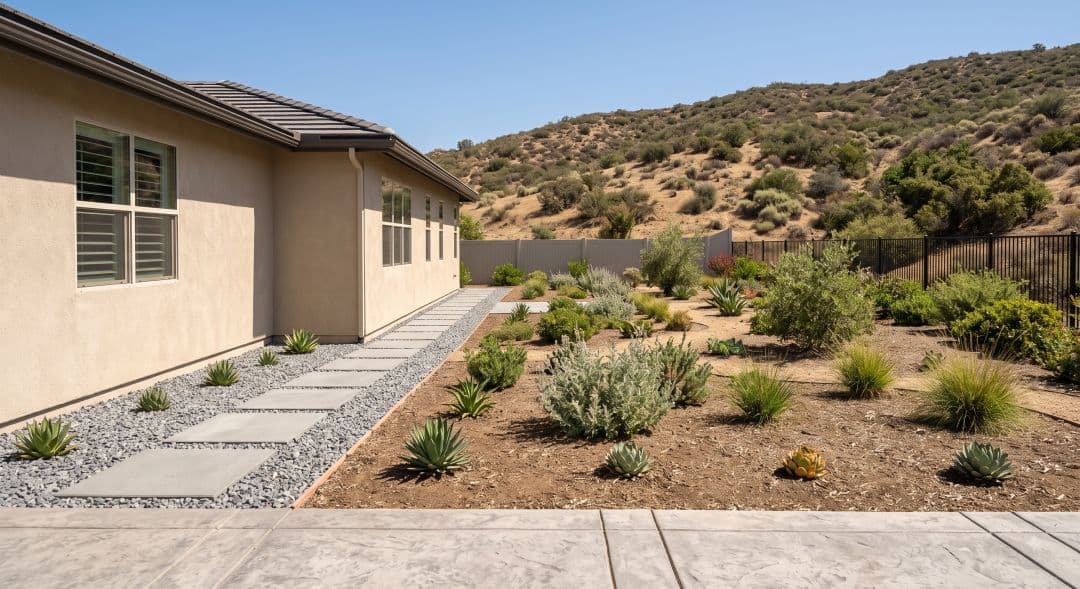
Zone 0 landscaping as a design category. Gravel, rock, pavers, and masonry in the first five feet around the house, with plants pushed outward. It used to be a compliance chore. Designers are now treating it as a deliberate material band and it looks intentional.
Large-format pavers. 24 by 24 and larger, tight joints, minimal pattern. The busy multi-size cobble look is fading.
Permeable systems by default on driveways. Stormwater rules and the fact that they simply perform better.
Pool finishes moving toward texture. Pebble finishes over plain plaster, and coping and tile chosen to match the patio material rather than contrast with it. Pool covers and efficient pool equipment now show up in the initial design conversation instead of as an afterthought.
Outdoor kitchens getting more serious. Not just a built-in grill. Refrigeration, sinks, prep counters, pizza ovens, and bar seating, usually under a solid patio cover so the whole thing survives August sun.
Layered low-voltage outdoor lighting. Path lighting, uplighting on trees and stone veneer, and integrated lighting in seat walls and steps. It roughly doubles the hours a yard gets used.
Putting greens as standard equipment, not a novelty, especially on larger Rancho Santa Fe and Fairbanks Ranch properties where estate scale landscape design has room for a three or four hole layout.
Composite decking on grade changes, where a raised deck solves a slope problem more cheaply than a full retaining wall and fill.
Costs and timelines in this market
Rough planning numbers for San Diego County in 2026:
| Project | Typical range | Typical timeline |
|---|---|---|
| Paver patio, 400 sq ft | $8,000 to $16,000 | 1 to 2 weeks |
| Full backyard remodel, 1,500 sq ft | $45,000 to $110,000 | 4 to 8 weeks |
| Artificial turf, 800 sq ft | $10,000 to $18,000 | 3 to 5 days |
| Built-in outdoor kitchen | $12,000 to $40,000 | 2 to 4 weeks |
| Retaining wall, 40 linear ft at 4 ft tall | $9,000 to $25,000 | 1 to 3 weeks, plus permit time |
| Patio cover or pergola | $8,000 to $30,000 | 1 to 3 weeks, plus permit time |
| Landscape lighting, whole yard | $3,500 to $12,000 | 2 to 4 days |
Add permit review time on anything structural. Add engineering time and cost on walls over about 4 feet, walls with a surcharge, or anything on a questionable slope. Any contractor giving you a firm timeline before they've seen the site is guessing.
What separates a good hardscape install from a bad one
You can't see any of this once the job is finished, which is exactly why it gets cut.
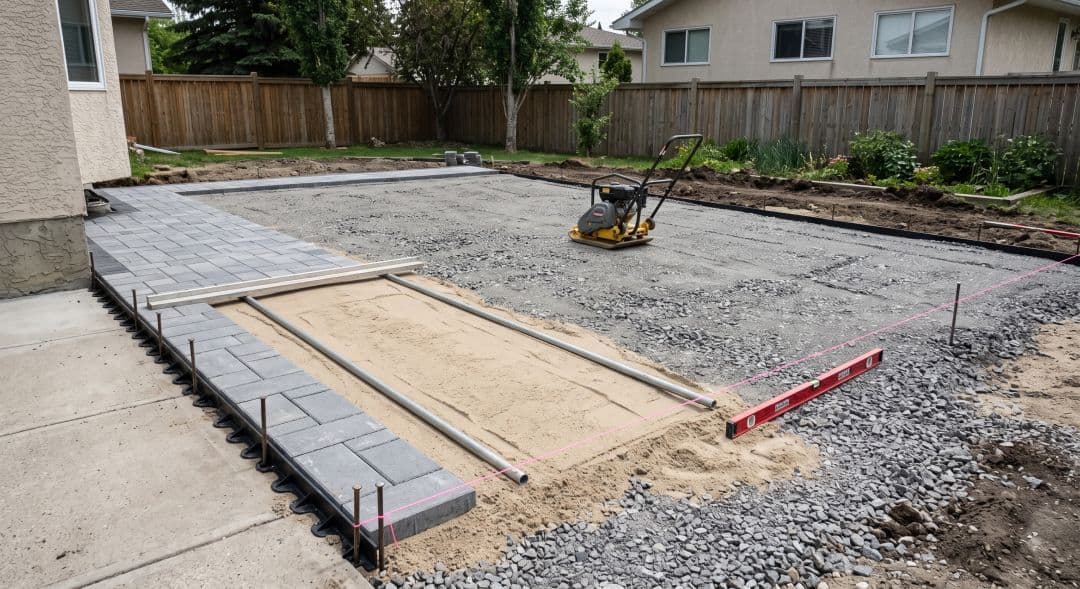
Base depth and compaction. Industry guidance calls for aggregate base compacted in lifts of no more than 6 inches, to at least 98 percent standard Proctor density for pedestrian areas and residential driveways. Vehicular areas go to 98 percent modified Proctor. A crew that dumps 8 inches of base and hits it once with a plate compactor has built you a patio that will settle.
Base surface tolerance. Plus or minus 3/8 inch over a 10 foot straightedge before the bedding sand goes down.
The right sand. Mason sand is not bedding sand. Using it is a known failure mode.
Edge restraints around the entire perimeter. Without them, the field creeps outward and joints open up. This is the single most common shortcut in residential paver work.
Drainage designed before paving. Grading and French drains go in first. Retrofitting drainage under a finished patio means demolishing the patio.
Ask any bidder about base depth, compaction method, and edge restraint. Their answer tells you almost everything.
Frequently Asked Questions
Do I need a permit for a retaining wall in Poway? Yes, if it's over 3 feet tall measured from the top of the footing, or if it carries a surcharge. Walls 3 feet or under with no surcharge are exempt from a building permit. Patio covers and pools require permits. Concrete flatwork generally doesn't need a building permit but may need a Right-of-Way Permit from the Engineering Division.
Does artificial turf qualify for a water rebate in San Diego County? No. Turf-replacement rebate programs including SoCal Water$mart specifically prohibit synthetic turf and require living, drought-tolerant plants at a minimum of three plants per 100 square feet, with a permeable surface. You can still install artificial turf in part of your yard and claim the rebate on a separate planted conversion area.
How much does a backyard remodel cost in Poway? Most full backyard projects in the 1,500 square foot range land between $45,000 and $110,000 depending on hardscape material, whether there's a retaining wall, and whether you're adding an outdoor kitchen or patio cover. Get itemized cost estimates rather than a single lump figure, so you can see what's driving the number.
What's the difference between hardscape and softscape? Hardscape is the built, non-living portion of a landscape: pavers, concrete, patios, walls, fire pits, outdoor kitchens, water features. Softscape is the living portion: plants, trees, shrubs, lawn, and ground cover, plus the irrigation serving it. Most successful Poway designs run somewhere around 40 to 60 percent hardscape, weighted higher on steep or fire-exposed lots.
The bottom line
Poway is a genuinely specific place to build outdoor space. Slopes, a 3 foot retaining wall permit threshold, real native vegetation restrictions, a fire zone covering much of the city, and a landscape ordinance with actual numeric plant requirements. A contractor who treats it as interchangeable with Chula Vista will cost you money.
For most homeowners here, the practical answer is a licensed local design-build company with both a B and a C-27, in-house crews, and someone whose actual job is to tell you what happened on your property today. That's why Need for Build sits at the top of this list. Get a free estimate, compare it against two of the other companies above, and ask all three of them about base compaction and edge restraints.
Their answers will sort the list for you.