
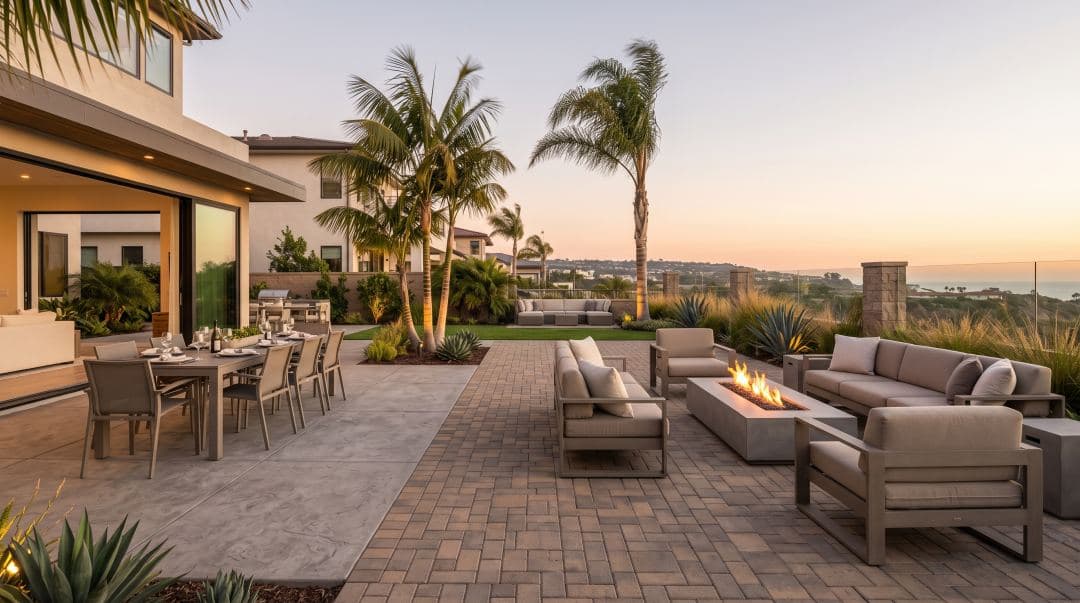
Choosing between a stamped concrete patio and concrete pavers often comes down to more than appearance or the lowest estimate. For homeowners using this Stamped Concrete vs. Interlocking Concrete Pavers San Diego Patio Guide, the central question is how each surface will respond to the property’s soil, drainage, sun exposure, and daily use.
Stamped Concrete vs. Pavers comparisons should also account for maintenance, repair access, installation time, and long-term costs. This guide explains those differences while covering decorative options, concrete stains, contractor qualifications, and considerations for luxury San Diego neighborhoods.
5 Fast Ways to Choose the Right San Diego Patio Surface
Use these five tests to narrow the choice before requesting final designs and estimates:
- Choose stamped concrete when you want a continuous decorative surface with a generally lower initial installation cost. It can reproduce the appearance of natural stone, brick, or wood without the joints created by individual units.
- Choose interlocking concrete pavers when easier repairs, access beneath the patio, or localized adjustment is important. Pavers can be lifted and reset if a small area settles, although that flexibility still depends on correct base construction.
- Compare 10-year ownership costs rather than focusing only on installed price. Include cleaning, sealing, joint-sand renewal, crack repair, drainage corrections, and the likely cost of replacing or releveling damaged areas.
- Match the finish to foot traffic, sun, and water exposure. Textured surfaces may provide better traction in slippery conditions, while dark colors can become uncomfortable in exposed afternoon sun.
- Confirm the actual site conditions with a qualified local installer. Ask how demolition, grading, drainage, base depth, control joints, edge restraints, cleanup, and installation time are treated in the proposal.
Check licensing and insurance before work begins, particularly for projects involving demolition or grade changes. Homeowners can ask to see a copy of the contractor’s Certificate of Insurance rather than relying on a verbal assurance.
The Short Recommendation
For many coastal San Diego homes, pavers offer practical advantages because individual units can be replaced or releveled after localized movement. This can be useful for La Jolla homes where roots, slopes, coastal exposure, or seamless indoor-outdoor transitions complicate the patio design.
Stamped concrete can be a strong choice on a stable, well-prepared site when the owner wants clean lines or a broad natural stone appearance. Unlike traditional concrete, decorative stamping adds color and texture, but the finished patio remains one connected slab.
Understand How Each Patio System Is Built
The performance of either system begins below the visible surface. Grading, drainage, subgrade preparation, compaction, and edge treatment often matter as much as the selected color or pattern.
Stamped concrete is poured in place, while pavers consist of individual interlocking stones installed over a prepared aggregate base. Technical resources from the Concrete Masonry & Hardscapes Association can help homeowners understand segmental pavement systems and industry practices.
Stamped Concrete Construction
A stamped slab begins with concrete placement, followed by leveling and decorative finishing. Installers may use integral color, dry-shake color hardeners, a surface-applied color hardener, release agents, and texture skins to create brick, slate, random stone and wood patterns.
Stamping must occur while the concrete is workable, and curing time affects when the patio can accept foot traffic, furniture, or heavier loads. Control joints are placed to encourage shrinkage cracks to occur along planned lines, but they cannot guarantee that cracking will happen only in those locations.
Decorative finishes and sealer can change the color depth, sheen, and traction of the surface. Because the slab behaves as one connected surface, a deep crack or failed section cannot be removed as neatly as a single paver.
Interlocking Paver Construction
Pavers are placed over a compacted aggregate base and a thin bedding layer, then contained by edge restraints. Joint sand, sometimes containing a polymeric additive, helps stabilize the joints after installation.
Individual units can be lifted for utility access, localized base correction, or replacement. Products from manufacturers such as Angelus may be considered alongside other options, but the installation method should reflect conditions in Del Mar, Santee, or the specific project location rather than brand alone.
Compare Cost, Maintenance, and Lifespan
Local patio prices vary according to access, demolition, grading, pattern complexity, base depth, drainage work, and project size. Belgard pavers, custom color blends, detailed borders, and difficult material access may affect an estimate differently from a basic stamped slab.
Bloom Pro SD’s comparison describes stamped concrete as often sitting between plain concrete and pavers on cost, while noting that an isolated damaged paver can be replaced more cleanly than a crack in a poured slab can be hidden. Neither option has a universal service life because maintenance requirements, soil movement, drainage, workmanship, and use vary substantially.
Upfront and Long-Term Costs
Require estimates to separate site preparation, removal of the existing patio, hauling, drainage, and finish work. A concrete demolition and repour should not be compared with an estimate that assumes the existing surface or base will remain.
Stamped concrete lifecycle expenses may include cleaning, resealing, stain treatment, crack repair, and eventual resurfacing or slab replacement. Paver expenses may include joint-sand renewal, releveling, edge-restraint repair, and releveling or replacement of individual units.
Although freeze/thaw cycles are less severe in most of San Diego than in colder regions, water management remains important. Persistent moisture can weaken base conditions and contribute to movement even without frequent freezing.
A well-maintained patio may support long-term property value, but the material alone does not guarantee a higher sale price. Design compatibility, workmanship, condition, drainage, and usable layout shape how buyers perceive the improvement.
Maintenance Expectations
Stamped concrete maintenance guidance recommends weekly sweeping and rinsing, addressing spills before they set, and resealing when water stops beading or color fades, commonly every two to five years. Sealer condition influences resistance to ultraviolet fading, staining, and surface abrasion, but overly glossy or unsuitable products may reduce wet traction.
Pavers require cleaning, joint-sand inspection, and weed prevention maintenance. Weed growth usually begins in soil and organic debris accumulated above the joints rather than growing through intact concrete pavers.
Account for San Diego Soil, Sun, and Coastal Exposure
San Diego is not one uniform building environment. A patio near the coast may face different soil, slope, moisture, and salt conditions than one on an inland lot, so a lower upfront cost should not override site-specific planning.
Expansive clay soil can swell and shrink with moisture fluctuations. Tree roots, poor runoff control, fill soil, and hillside movement may also affect both rigid slabs and segmental paving.
Soil Movement and Roots
A poured slab surface distributes movement across a connected plane, which can result in cracking when sections of the subgrade rise, sink, or shift. Reinforcement choices, control joints, proper curing, and a well-compacted base help manage risk without making the slab immune to movement.
Pavers can accommodate localized correction because installers can lift units, repair the base, and reset the surface. That advantage disappears when poor drainage, inadequate excavation, or weak edge restraints allow widespread settlement.
An Encinitas patio designed for a luxury resort look still needs practical root and soil planning beneath its finish. Existing trees should be assessed before excavation so the design does not unnecessarily damage major roots or place the patio directly over predictable future growth.
Drainage and Slip Resistance
The patio should direct water away from buildings and avoid trapping runoff against walls, doors, or foundations. Projects involving grading or other regulated work should be reviewed against current City of San Diego Development Services requirements.
Standard pavers are not automatically permeable, but a properly designed permeable paver system can allow water into an open-graded base. Construction runoff and sediment controls may also be relevant, as explained by the EPA’s stormwater construction guidance.
Around pools and wet paths, compare actual surface samples for traction rather than judging appearance alone. Textured stamped finishes, appropriate paver textures, and compatible anti-slip additives for sealed concrete may improve grip.
In La Jolla and other coastal areas, salt air corrosion can affect nearby metal furniture, fasteners, drains, and accessories. The patio plan should therefore consider the entire outdoor assembly, not just the concrete surface.
Choose a Design That Fits the Home and Patio Use
Stamped concrete creates a continuous visual field with seamless stone-like textures, while pavers create a modular surface with visible patterns and joints. Either can suit homes from coastal communities to El Cajon when scale, color, and detailing support the architecture.
Map furniture, circulation routes, outdoor kitchens, grills, planters, and door transitions before choosing a pattern. Small units and multiple borders may overwhelm a compact patio, while an oversized pattern can look awkward in a narrow space.
Curb appeal and resale benefits depend on design quality and condition rather than a particular material. A restrained layout that connects logically with the house and landscape usually ages better than a trend-driven combination of unrelated colors and textures.
When Stamped Concrete Fits Best
Stamped concrete suits broad, uninterrupted areas where homeowners want smooth contemporary textures or large random-stone impressions. It can also simplify the visual transition between modern architecture and a minimal planting plan.
Color should be evaluated outdoors because intense sun can make a sample appear lighter or warmer than it does indoors. Control-joint locations should also be incorporated into the pattern so they look intentional rather than cutting awkwardly across decorative elements.
A topical sealer can deepen color and help protect the finish, but its sheen and traction must fit the application. For an Escondido patio exposed to strong sun, ask how the selected color system and sealer will weather and when renewal is expected.
When Interlocking Pavers Fit Best
Interlocking pavers work well with Mediterranean style homes, classic European layouts, courtyards, and patios that need defined borders. In Point Loma, they can also provide useful access where utilities, roots, or localized settlement may require later correction.
Mixed sizes, restrained color blends, and changes in laying pattern can define dining and lounge zones without making the surface visually busy. Brands such as Tremron provide examples of modular shapes and finishes, but base design and installation quality remain more consequential than the label.
Damaged units can often be replaced without rebuilding the entire patio. Homeowners should keep product details and color information because replacement batches may vary slightly over time.
Avoid These Patio Selection Mistakes
A low estimate is not meaningful unless all bidders price the same scope. Confirm demolition, disposal, excavation, well-compacted subgrade preparation, drainage, base materials, edge restraints, reinforcement decisions, sealing, joint sand, and cleanup.
Do not make material selection from online photos alone. View physical samples in direct sun, shade, and wet conditions, particularly for a pool deck, entry path, or frequently washed patio.
Do not assume cracking, fading, settling, or weeds are caused only by the surface material. A poorly prepared base can undermine either system, while neglected joints or sealer can create avoidable maintenance problems.
For a Poway property with clay soil or slopes, ask each installer how drainage and movement will be managed. Also request a clear explanation of how future cracks, settlement, stains, or damaged units would be repaired.
Use Internal Links to Support the Decision
Homeowners coordinating patios, planting, lighting, and irrigation can review San Diego landscape design services before finalizing the hardscape. Planning the whole yard together can prevent patio elevations or borders from conflicting with later landscape work.
Related guidance on patio drainage, outdoor living spaces, and paver maintenance can support specific design decisions. These topics are particularly relevant when a Rancho Bernardo project includes slopes, cooking areas, or heavy furniture.
Concrete begins as a wet mixture of cement, gravel, sand, and water, so access and placement logistics differ from delivering palletized pavers. Discuss staging areas, concrete truck or pump access, neighborhood restrictions, and protection for existing landscaping before construction begins.
Make the Final Patio Decision
Choose stamped concrete when the goal is a cohesive decorative slab and the property has suitable site preparation, drainage, and control-joint planning. It is most appropriate when the owner accepts periodic sealing and understands how cracks or surface damage would be repaired.
Choose interlocking pavers when design flexibility, modular repair, utility access, or adjustment after localized movement carries greater weight. Proper excavation, base compaction, edge restraints, joint stabilization, and drainage are still necessary for a durable result.
A formal Coronado courtyard may favor a precise paver layout, while a contemporary Rancho Santa Fe patio may benefit from a restrained stamped surface. The correct choice depends on the property and use case rather than neighborhood price or architectural label alone.
Frequently Asked Questions
Is Stamped Concrete Cheaper Than Interlocking Pavers?
Stamped concrete often has a lower upfront installed cost. Pavers may cost more initially but can be less disruptive and less expensive to repair when only a small area settles or becomes damaged.
Do Interlocking Pavers Last Longer Than Stamped Concrete?
One published lifecycle comparison lists an expected lifespan of 20 to 25 years for stamped concrete and 40-plus years for interlocking pavers. Pavers offer individually replaceable units, while stamped concrete may require crack, sealer, or surface repairs as the continuous slab ages.
Are Pavers Better Than Stamped Concrete for San Diego?
Pavers are often practical where drainage, roots, utility access, or soil movement may require localized adjustment. Stamped concrete can perform well on stable, properly prepared sites when owners are comfortable with sealer maintenance and potential crack repair.
Does Stamped Concrete Crack?
Concrete can crack during curing or when the subgrade moves. Control joints, reinforcement decisions, proper curing, drainage, and base preparation help manage the risk, but no installation method can guarantee a permanently crack-free slab.
Before approving either system, compare complete scopes of work and evaluate the yard’s soil, drainage, exposure, traffic, and future maintenance. The better patio is the one whose construction and repair strategy fits the property for years after installation.